Feeling What You're Seeing
On taking the image out of imagination

Every Tuesday and Thursday, I publish personal essays and fiction that find new ways to look at the everyday.
My mind’s eye is broken.
Well, maybe not broken, but it definitely doesn’t work like it’s supposed to.
A few years ago, I discovered that people can actually see an object in their head. Like a photo popped into their brain. Me, on the other hand, I’ve got an empty void. A black hole, if you will. Not of thoughts, but of images.
It’s all thanks to aphantasia.
I know the word sounds like Fantasia, making you think bright images directly from a rainbow’s imagination play in my head like a Disney simulator ride.
It's quite the opposite. In fact, on a scale from an apple so real it’s basically in my head to nothing, I’ve got nothing—or a 5 in the chart below.
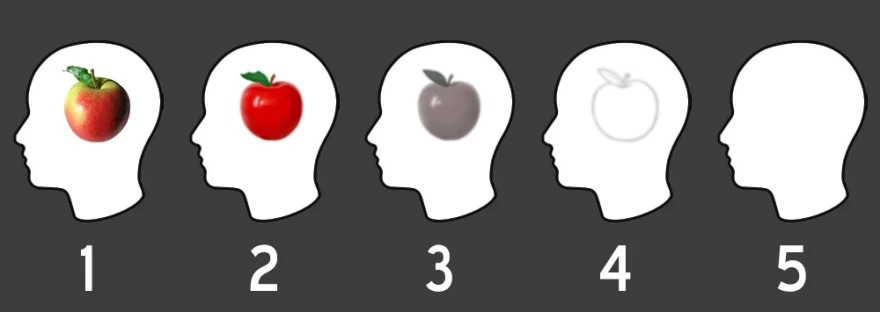
Those who can see the apple have as hard a time understanding me as I do them.
I know this because my husband and I get into lengthy discussions about it.
Frequently.
Often enough that I’ve developed a script to describe it:
Imagine you’re studying for a test. (In concept, of course. You don’t need to be a showoff by picturing it.)
You spend hours staring at the words on a page, learning information you’re definitely going to forget five minutes after turning in your work. Now you’re at the test, and you’re thinking really hard about the answers, sifting through everything you crammed the night before.
Barring those with photographic memories, I’m going to guess that you’re remembering the ideas of what you studied, not the literal words on the page. That’s what it’s like for me. I know what blue looks like; it’s just that, when I think about it, it's an idea, not an actual color.
Once I discovered this… interesting variance…the pieces started clicking together.
For example, I remember reading Frankenstein in school and hating it.
A three-page description of the Alpine landscape?
It felt interminable to my aphantasic brain. I didn't realize it at the time, but now I understand that my lack of mental images was the reason I skimmed through most physical descriptions. Before that, I’d concluded those kinds of books were not my thing, and didn't give it any more thought.
Besides, when I listened to audiobooks, I found that my ear picked up on physical descriptions. Not that they fully registered, and I definitely didn’t remember them all the way through unless they were repeated enough times. But I noticed them.
What else could there be from the reading experience? I understood the story; I loved the characters; I felt the emotions.
It wasn’t until I discovered fan art that I learned what I was missing. Seeing people’s illustrations of the words suddenly made the descriptions feel important. Suddenly, I became jealous of all of you people who don’t need Instagram to have that experience.
At least some of you are nice enough to share the wealth.
I’m not without imagination, though.
I think what confused my husband the most as we learned about aphantasia is that I decorated our entire house, from paint colors to rugs to backsplash. He kept asking, “How were you able to know what it was going to look like?”
My answer was always the same: “No idea. I just did.”
I couldn’t picture the different choices together, yet some part of my brain processed images enough to know when things worked—and photo collages helped me double-check.
These conversations led me to think about workarounds I may have unknowingly developed. What does my brain do to compensate?
The answer appeared in my writing. And once I saw it, I couldn't believe how obvious it was. After I sent my early draft of Ink & Wood to family and friends, the most common feedback I received was that I didn't have enough descriptions.
The first time I heard it, I immediately thought, does it really matter? Because it didn’t to me. Then I heard the same feedback several more times. Okay then. It clearly matters to others. No problem. I can sprinkle in hair color and clothing descriptions and other details that felt extraneous to me.
I can give the people what they want.
But then later, someone told me I use too many adjectives. Really? Did I overcorrect somehow?
As soon as I heard that one, I looked through several of my essays and stories. It didn’t seem like there were a whole lot, but that was based on my perspective, and maybe I like a lot of adjectives now?
Time to put my obsessive research skills to work! Down a rabbit hole I went. I went so deep that even my daughter told me I needed to let it go. I believe her exact words were, “Mommy. Get over it.”
I didn’t.
Instead, I researched the average adjective count in similar length essays. Then I ran several of my published pieces through AI and asked it to count how many I had. I learned that not only do I not use a lot, my writing actually contains half of the lowest number in the average range.
That was helpful, but I wasn’t done yet. I fell further down the hole. I needed to understand what was at the root of this feedback because clearly my writing felt adjective-y, or I wouldn’t have received the comment.
How many of you are now thinking what my daughter was thinking? I won't be offended. It's a reasonable conclusion. Jokes on you though, my rumination gave me an answer.
It's my aphantasia.
In compensating for the lack of imagery, I (over?)developed my analytical and emotional processing. And experiencing my inner world rather than seeing it gave me a different vocabulary for descriptions. One that relies on metaphor, emotion, and concepts to describe the visual world. One that permeates my writing and brings you, my dear reader, into my world where imagination doesn't rely on the mind’s eye.
And that holds just as much value as a paragraph dedicated to exactly what shade of green the grass is under the warm glow of the rising sun.
So I’ll make you a deal.
Those of you who can see your images keep making me the fan art, and I’ll keep making you feel the things you can see.
Where are you on the scale above? Are you a real apple or a blank space too?
Check out The Breadth of Wonder to see what happens when inspiration hits in the middle of the night.
I’m with you. I find stuff like this endlessly fascinating. Probably because it seems so similar to my neurodivergence’s. HOW exactly am I different? WHY can’t I figure out what I’m looking at? WHAT kind of compensatory habits have I unconsciously developed?
<3